
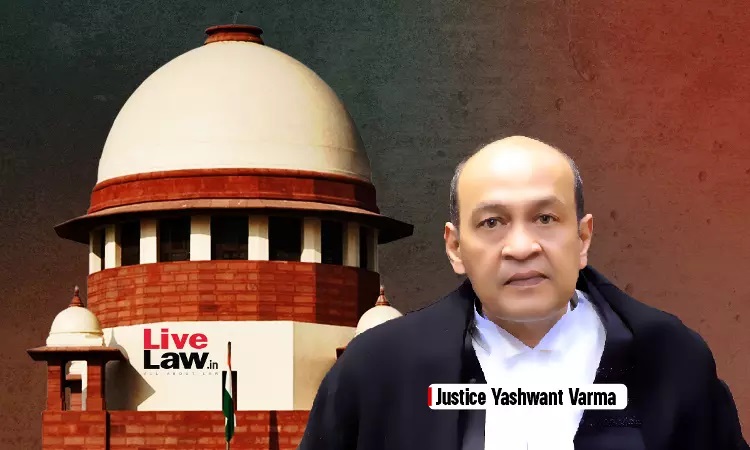
New Delhi:
The Supreme Court dismisses justice for Yashwant Varmas, pledging to challenge the CJI’s recommendation for his removal
Judge Yashwant Varma of the Allahabad High Court filed a writ petition against the in-house inquiry report that implicated him in the case-at-home scandal. The Supreme Court dismissed the petition today, August 7, along with the recommendation made to the President and Prime Minister by Sanjiv Khanna, the Chief Justice of India at the time, for Justice Varma’s removal. The ruling was delivered today by a bench that included Justice AG Masih and Justice Dipankar Datta. The bench had reserved the decision on July 30.
The bench’s initial ruling said that the writ petition could not be considered at all due to Justice Varma’s participation in the internal investigation and subsequent doubts about the in-house panel’s ability to carry out the investigation. Given the significance of the constitutional concerns raised, the bench decided to decide the other five issues even though the writ petition was determined to be unmaintainable.
The following were the other questions posed: 1. Is the investigation authorized by law? 2. In terms of the method, is the investigation and the resulting report a separate extra-constitutional mechanism? “We have stated that the procedure has legal sanction.” While delivering the ruling, Justice Datta said, “We have also held that it is not a parallel and extra-constitutional mechanism.” 3. Does Paragraph 5B of the in-house procedure violate Article 124 and Articles 217 and 218 of the Constitution and deny a High Court judge any fundamental rights? According to Justice Datta, “The answer is in the negative”
“Here, we have held that the CJI and the committee constituted by the CJI have scrupulously followed the procedure, except one-that is, the uploading of the video footage and the photographs.” 4. Did the CJI or the committee constituted by the CJI act in accordance with the procedure or in deviation from it? According to protocol, we have decided that uploading the images and videos of the firefighting operation to the SC website was not necessary. However, since you didn’t query it when the time was right, we have maintained that nothing activates it. Furthermore, the writ petition makes no claims for remedy regarding the uploading,” said Justice Datta.
Does the procedure’s paragraph 7(2), which mandates that the CJI send the report to the President and Prime Minister, violate the Constitution? “We have held that it is not unconstitutional,” the bench declared. The bench also addressed the argument that the judge was not given a hearing chance prior to sending the report to the PM and the president. According to the bench, the procedure did not necessitate this. The petitioner cannot assert this power as a matter of right only because another judge was granted it in a different case. he bench further reserved Justice Varma’s right to present his arguments in any impeachment proceedings that might be brought against him.
Additionally, the bench denied Advocate Mathews J. Nedumpara’s writ petition, which sought to register a formal complaint against Justice Varma, citing “abuse of process of the Court” and “the making of incorrect submissions on oath by the petitioner.” Justice Varma was represented by Senior Advocates Kapil Sibal and Mukul Rohatgi. ‘XXX’ was used as the anonymized name of Justice Varma when the petition was filed.
Sibal’s main contention was that, in accordance with Article 124(4), a judge could only be removed for “proved misbehavior” or “incapacity.” The internal process that permits the Chief Justice of India to write to the President suggesting that the impeachment process be started is unconstitutional. The recommendation of the CJI cannot serve as the foundation for the impeachment process. However, Justice Datta had stated that the petitioner could not be upset at this point because the in-house procedure is merely an ad hoc preliminary investigation and its report is not even considered evidence.
During a firefighting operation on March 14, a massive stack of cash notes was inadvertently found at an outhouse of Justice Varma’s official residence. At the time, Varma was a Delhi High Court judge. Three judges—Justice Sheel Nagu, who was the Chief Justice of the Punjab & Haryana High Court at the time; Justice GS Sandhawalia, who was the Chief Justice of the Himachal Pradesh High Court at the time; and Justice Anu Sivaraman, who was a judge on the Karnataka High Court—formed an internal inquiry committee after the discovery caused a great deal of public controversy. While the investigation was ongoing, Justice Varma’s judicial duties was suspended and he was returned to the Allahabad High Court.
After Justice Varma disregarded the CJI’s recommendation to step down, the committee turned in its report to CJI Khanna in May, and the CJI sent it to the President and the Prime Minister for additional action. The three-judge in-house inquiry committee found Justice Varma’s actions during the March 14 fire event, which resulted in the cash notes’ discovery, to be abnormal, which led to some negative conclusions about him.
The committee concluded that cash was discovered in Justice Varma’s official property after reviewing technological evidence, including videos and photos taken by fire department personnel, and 55 witnesses, including Justice Varma and his daughter. The committee concluded that Justice Varma and his family members had “covert or active control” over the storehouse, and that it was his responsibility to explain why there was money there. The committee determined that there was adequate justification to suggest action against the judge since he was unable to fulfill his duty by providing a credible explanation other than a “flat denial or a bald plea of conspiracy.” MPs holding the necessary signatures from the Rajya Sabha and Lok Sabha have circulated notices of impeachment.
XXX v. THE UNION OF INDIA AND ORS|W.P.(C) No. 699/2025 is the case details. Reference: 2025 782) LiveLaw (SC) Look: Justice Verma was also represented by Senior Advocates Kapil Sibal, Mukul Rohatgi, Rakesh Dwivedi, and Sidharth Luthra, as well as Advocates George Pothan Poothicote and Manisha Singh.


